|
by Dennis Walikainen, senior editor
“A Night at the
Opera” was either a Marx Brothers movie or an album by Queen before
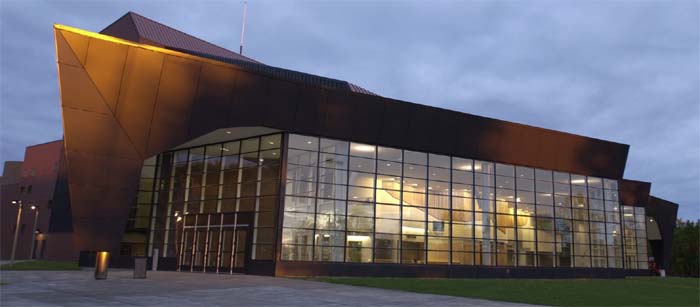
Saturday night at the Rozsa Center. There, we were transported out of
Houghton as the Keweenaw Symphony Orchestra led us to another world, or
two.
A mix of generations was represented by both the orchestra
and the large crowd, not bad for a Saturday night.
The pieces
chosen were familiar to all, even us rookies, beginning with Suppé’s
“Poet and Peasant Overture.” It had a great, western feel to it,
sounding somewhat like Copeland. At times, it seemed like the perfect
music to a chase scene with a stagecoach racing through the mountains.
Then, it became calliope-like, music for a carousel. After
mellowing out, when the entire orchestra played at once, it was sonic
bombast, and I straightened up in my chair.
The sound of a
German band segued into a waltz feel, and the “Peasant” part of the
piece next became jazzed up. The ending was Beethoven-like, powerful.
Music director and conductor Joel Neves then spoke about the
theme of the evening and many operas: “husbands killing wives,” which
was particularly interesting since his wife, Lara, would be singing this
night. He stressed that they would be “going home together and
everything would be fine.”
Selections from Verdi’s “Otello, Act
IV” were next, and the mourning and sadness were played out nicely by
the horns and woodwinds. “Music is what feeling sounds like,” Neves
reminded us, and this section proved it.
The sorrow built, then
the “Willow Song” brought it home, Lara Neves’ singing over heavy bass
tones. It was the perfect death song, if there can be such a thing. The
soaring sadness, with flutes being birds, continued until the tympani
made us jump: terror taking its place in this death march.
The
subtitles allowed us to make sense of the Italian and appreciate the
aura of the original music.
We moved from the dark into the
light of “Ave Maria,” more spiritual and liberating, when Verdi wrote of
prayers for the “innocent” and the “weak oppressed” and for
“compassion.”
A pastoral feel was achieved as the instruments
kicked in, and Neves’ singing floated above the sound, like a dove.
“Hail Mary . . . and at the hour of our death
Hail! Amen!”
Not a bad way to go.
At intermission, I caught up with
another first-timer. “It’s really good, isn’t it?” he confessed in
hushed tones.
After the break, Bizet’s “Carmen” included many
more familiar tunes: “All the greatest hits in one album,” Neves joked,
and it was true. We knew many of melodies.
It also started
ominous, and the orchestra moved in and out of pizzicato (picking at the
strings), and when they all came together, they really took us to
another place.
Then the first “gypsy” feeling: Bohemian, with
much counterpoint among the instruments. It all became very modern.
Later, the familiar tones sounded like a soundtrack to an old baseball
movie or an introduction to springtime (we can hope).
It moved
into a near militaristic piece, in both cadence and power. They had our
attention.
The march segued into “Habanera,” the song we all
know, about love, which you never know, so Bizet tell us.
I felt
the subtlety, especially in Lara's voice, until she cut loose. Then, the
passion of the piece was hammered home. “If I love you, you best
beware!”
Got it.
A needed instrumental break came as
“Nocturne," “Chanson du Toréador,” and “La Garde Montante” sounded at
times like Tchaikovsky’s “Nutcracker,” and at other times, the violins
all sounded as one, even more powerful.
Then you realize, “I
heard this on a commercial,” for a moment uniting high and pop culture.
(Now, I’m a critic!)
Brass takes over with the flutes and
piccolos leading the way and the pizzicato resumes, dancing along until
“Gypsy Song.”
And the music describes their dancing, “the rhythm
of the song, all hot and crazy, fevered, sweating . . . letting the
whirlwind carry them along.”
That summed up the evening, too. We
were carried along, a long way from Houghton, and the musicians and the
Neveses deserved their long and loud standing ovation.
You could
say they had the place rocking.
|